Discover. Connect. Inspire.

LikeWar

The Weaponization of Social Media
By P. W. Singer and Emerson T. Brooking

Fluke

Fluke – Chance, Chaos and Why Everything We Do Matters; by Brian Klass dives deep into the interconnectedness of all human existence. Brian sprinkles his book generously with many thought-provoking anecdotes that very earnestly try to explain the total unity of the world. He very profoundly states that “The real story of our lives is often written in the margins. Small details matter and even, apparently insignificant choices of people we will never meet can seal our own fates, though most of us will never see that quiet so clearly.” Fluke is a remarkable book that asks us all to reconsider our “inescapable network of mutuality tied in a single garment of destiny.
Chance, Chaos, and Why Everything We Do Matters
By Brian Klaas

Think Again

The Power of Knowing What You Don’t Know
by Adam Grant

Creating a Learning Society

A New Approach to Growth, Development, and Social Progress
by Joseph E. Stiglitz

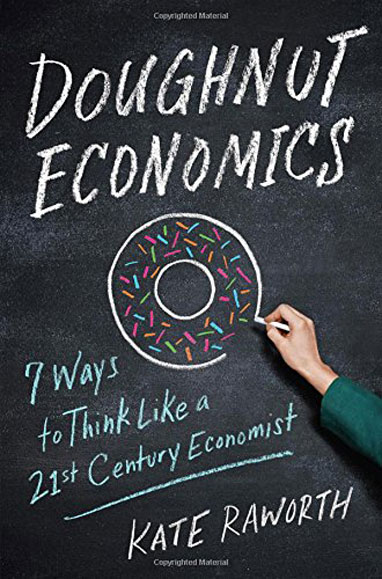
Doughnut Economics

Doughnut Economics – Seven Ways to Think like a 21st Century Economist by Kate Raworth, tackles the crisis in the teaching of economics which has consequences far beyond the university walls. She begins by asking, “What if we started economics not with its long-established theories, but with humanity’s long-term goals, and then sought out the economic thinking that would enable us to achieve them?” The author uses a doughnut to illustrate this. The essence of the doughnut is a social foundation of well-being that no one should fall below, and an ecological ceiling of planetary pressure that we should not go beyond. Between the two lies a safe and just space for all.
7 Ways to Think Like a 21st Century Economist
by Kate Raworth

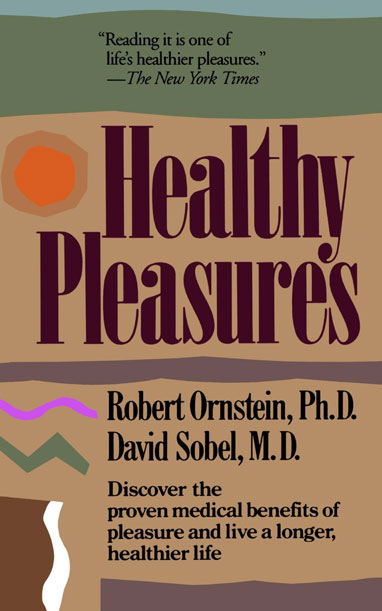
Healthy Pleasures

Healthy Pleasures co-authored by Dr. Robert Ornstein and Dr. David Sobel brings us all back to the basics. Written in the year 1988, its relevance is ever so more today. The book anchors itself in ‘The Pleasure Principle’; which lays out the path to a healthier life. It shows us through the lives of several people who have lived long and happy; how important it is to tap into the infinite, small joys of life. Laughing out loud over a joke, watching the Sun rise and set, listening or dancing to music, indulging in the occasionally treat; all of these simple everyday acts work as powerful factors that culminate in a life well lived. In today’s day and age, where we tend to be almost paranoid about what we eat; where we regiment our daily lives with the use of gadgets; Healthy Pleasures merely asks us to keep it simple and basic.
Discover the proven medical benefits of pleasure and live a longer, healthier life
by Robert Ornstein and David Sobel

The Weirdest People in the World

The Weirdest People in the World – How the West Became Psychologically Peculiar and Particularly Prosperous; by Joseph Henrich attempts to explain how and why a broad array of psychological differences emerged in Western Europe while simultaneously laying a foundation for thinking about human nature, cultural change and societal evolution. As both an anthropologist and a professor for economics/psychology; Joseph researched why countries differ in prosperity in relation to understanding human psychological variation. The word ‘WEIRD’ is actually an acronym which expands into Western, Educated, Industrialized, Rich and Democratic.
How the West Became Psychologically Peculiar and Particularly Prosperous
by Joseph Henrich

New World New Mind

Moving Toward Conscious Evolution
by Robert E. Ornstein and Paul R. Ehrlich

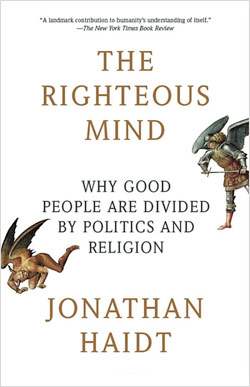
The Righteous Mind

The Righteous Mind – Why Good People are Divided by Politics and Religion; by Jonathan Haidt begins with a famous appeal by Rodney King on the 1st of May 1992, “Can We all get along?” This book is about why it’s so hard for us to get along. The title of the book conveys the sense that human nature is not just intrinsically moral, it’s also intrinsically moralistic, critical and judgemental. Politics and religion are both expressions of our underlying moral psychology and an understanding of that psychology can help to bring people together. The author’s hope is that this book will make conversations about morality, politics and religion more common, more civil and more fun, even in mixed company, so that we can all get along.
Why Good People Are Divided by Politics and Religion
by Jonanthan Haidt

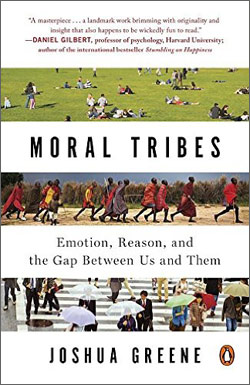
Moral Tribes

Author Joshua Greene’s book titles “Moral Tribes – Emotion, Reason and The Gap Between Us and Them”; explores the possibility of improving our prospects for peace and prosperity by refining the way we think about moral problems. The author uses three organizing metaphors, namely; a) The tragedy of commonsense morality. b) Morality, Fast and Slow. c) Common Currency. Joshua carries us along several thought experiments and finally makes his case for transcendence of our tribal gut reactions as an important approach to change the way we think and talk about the problems that divide us.
Emotion, Reason, and the Gap Between Us and Them
by Joshua D. Greene

Social

Why Our Brains are Wired to Connect
by Matthew D. Lieberman

Uncharted

In the book titled, “Unchartered – How to Map the Future Together”, author Margaret Heffernan takes us through very important questions tied to our need for absolute certainty. Citing several examples and using clear analysis, the author places the concept of uncertainty right at the heart of the conversation; and connects this recurring feature in our lives with opportunities for creative thought, deeper awareness of both self and surroundings and urges us to recognise the pitfalls of seeking predictive accuracy that delivers the impression of absolute certainty in our lives.
How to Map the Future Together
by Margaret Heffernan